
















 Radio
Radio

.jpg)
.jpg "Get Timeform ratings for every upcoming runner and past result, plus premium winner-finders including commentary, Flags, Pace Maps and lots more.")


 Url copied to clipboard.

In 2016, with just a few weeks of the Premier League season remaining, Leicester manager Claudio Ranieri attempted to rally his troops – successfully, as it proved – with the observation that “no-one remembers runners-up”.
That may be true for most professional sport, and has perhaps sometimes provided the added incentive to get a person or a team across the line. But it is not always true of horseracing, and it is definitely not true of The Derby.
The 1986 Derby is remembered by most as “Dancing Brave’s Derby”, even though he lost it to Shahrastani.
The 1984 Derby likewise, with El Gran Senor coming up agonisingly short against Secreto. More recently, the 2002 Derby is likely to be recalled as much for the runner-up Hawk Wing as for the winner High Chaparral.
Such wounds take a long time to heal – one correspondent on Twitter suggested it was “too soon” to revisit the Dancing Brave run – but often it is better to confront your demons than to leave them to fester.
One thing we have now is the ability to dissect such races in a way that was not possible then, including through sectionals. With this year’s delayed and behind-closed-doors Derby due off at 4:55 on Saturday, I thought I would undertake that task, focusing on those three memorable contests.
Firstly, it is necessary to have an idea of how horses “should” run the Derby in terms of sectionals. This may be achieved by averaging those times which have given rise to good Timeform timefigures at the course and distance, then doing the same for the sectionals which gave rise to them.
One thing that needs to be challenged is the idea that there is a perfect position to be in in the Derby, the one that Lester Piggott and Walter Swinburn used to occupy back in the day, on the flanks of the leader turning in.
It depends on pace, and how close to or far from optimum that pace is, though horses further back obviously have more rivals to negotiate their way round or through.
Since the 1970s, all of Secreto (1984), Erhaab (1994), Sir Percy (2006), Authorized (2007), Workforce (2010), Pour Moi (2011), Golden Horn (2015) and Wings of Eagles (2017) have been over 1.0s – seven lengths plus – in arrears of the leader at the crossing at the entrance to the straight.
That crossing is one of the chief markers on the Derby course, and comes 758 yards from home. Sectional pars tell us that the ideal time to hit the end of it is almost exactly 40.0s from the finish in a race run in an overall time of 2m 35.00s. That par figure decreases or increases on a pro-rata basis as the overall time increases or decreases.
This results in a par speed from that point of 111% of a horse’s average speed for the race overall. That very high figure (around 101% would be normal) is down to the unique Derby course, which rises hugely in the first half-mile, then swings left, before dropping markedly in the final half-mile.
The 1984 Derby
The 1984 Derby was one of the slower Derbys, run in an overall time of 2m 39.12s, but this was not down to the runners dawdling: quite the opposite. The leader completed the first half mile about 4.0s (over 20 lengths) faster than par and was 2.5s (around 15 lengths) ahead of it turning in.
El Gran Senor – the outstanding winner of an exceptional 2000 Guineas – and Secreto were some way back in mid-field, but not quite as far back as would have been ideal, particularly the former, who was a couple of lengths closer than the latter.
El Gran Senor cruised up to lead after 2f out as the pace collapsed, and Eddery even looked round contemptuously soon after. But Secreto, under pressure for much longer, drew on with him and ultimately worried him out of it to score by a short head.

Eddery ended up caught between two stools, finding himself hitting the front some way out in a race that had been run at a stamina-sapping pace.
Had El Gran Senor arrived later, sectionals – and the energy distribution they measure – suggest the result would have been slightly, but crucially, different.
Timeform rated El Gran Senor 136 and Secreto 128 in Racehorses of 1984.
🥊 Secreto vs El Gran Senor
— Racing TV (@RacingTV) June 30, 2020
Heartbreak for favourite backers as the great El Gran Senor is narrowly denied in the 1984 Derby at @EpsomRacecourse
Secreto never ran again, whilst El Gran Senor would go on to win the Irish Derby - this was his only defeat in eight races pic.twitter.com/GDDcDWLaT1
The 1986 Derby
Some of you may want to look away now.
The 1986 Derby was run at a fairer pace, but not at an entirely even pace. The leader was a few lengths ahead of par in the first half-mile but a length or two behind it by the crossing.
That slightly steady mid-section is where much of the trouble occurred for Dancing Brave, and his supporters, and for Dancing Brave’s veteran jockey Greville Starkey.
As best we can tell from the irresponsibly arty camerawork, Dancing Brave made up about five lengths on Shahrastani in the straight but needed to make up nearer six. And he made up the majority of that in the final 1f, which he completed in about 11.85s compared to Shahrastani’s on-par 12.35s, but was still half a length down at the line.
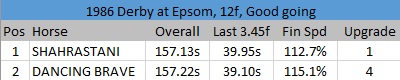
Whereas the finish of the 1984 Derby had been slow, the finish of the 1986 Derby was a bit faster than par, and those splits – expressed in pounds – say Dancing Brave “should” have won by a length or two.
Starkey was guilty then? Not so fast.
Watch the video of the 1986 Derby again, if you can: having been settled behind, Dancing Brave is rousted along briefly after 4f, possibly through getting buffeted in a big field, and again 4f from home.
Nothing much happens, even after Dancing Brave is switched into the clear with 3f to go, until the final 300 yards, where – in the words of the commentator – Dancing Brave had “oh so much to do”: ultimately, and agonisingly, he could not quite do it.
But Starkey wanted to be closer sooner, and, for whatever reason, Dancing Brave took too long to respond.
A number of things counted against the duo, including a pace that failed to sort the wheat from the chaff until late in the day. Shahrastani was also, inconveniently for Dancing Brave’s legions of supporters, a very good horse who had things go perfectly for him.
In Racehorses of 1986, Dancing Brave was rated 140 and Shahrastani 135.
💚 Shahrastani - the 1986 winner of the Derby at @EpsomRacecourse for Sir Michael Stoute, Walter Swinburn & @AgaKhanStuds
— Racing TV (@RacingTV) June 30, 2020
As for Dancing Brave... heartbreak for his supporters #thegreatestrace pic.twitter.com/EaRzzXM1qe
The 2002 Derby
The things that went wrong for Hawk Wing in the 2002 Derby were neither his nor his jockey’s fault.
The ground turned to “good to soft” (the time is the second-slowest so far this century), the early gallop was unrelenting, he had a high-class rival in High Chaparral, and the race was at 12f, not 10f. But that’s British weather and the one-and-only Derby for you.
The leaders were well ahead of par from an early stage and still about 10 lengths ahead turning in. Both Hawk Wing and High Chaparral had sensibly been settled well back, but the latter made his move just before the straight and got to the front approaching 2f out as the pace-setters wilted.
Hawk Wing bore down on him, menacingly, but never quite got past and was done with in the final 1f (which High Chaparral completed in a relatively slow 13.25s). The pair pulled 12 lengths clear of a horse (Moon Ballad) who won a Dubai World Cup nine months later and their splits from the turn were similar.

High Chaparral was rated 130 – a superior Derby winner, for sure – and Hawk Wing 127 in Racehorses of 2002, and neither suffered long-term damage from such a bruising encounter, being rated 132 and 136 respectively the following year.
Hawk Wing, who become something of a Marmite horse with the public and sections of the media, never ran at 12f again.
🗣️ "A race that had it all." @Timeform's Flat Editor @davidjohnsonTF explains why the 2002 Derby - which High Chaparral and Hawk Wing fought out the finish in - is his favourite Derby memory 👇 pic.twitter.com/FuXGJfhBwb
— Racing TV (@RacingTV) July 1, 2020
Also read:
Rowleyfile preview: Investec Handicap
.jpg&w=300)
.jpg&w=300)
.jpg&w=300)

.jpg&w=300)


