
















 Radio
Radio

.jpg "Get Timeform ratings for every upcoming runner and past result, plus premium winner-finders including commentary, Flags, Pace Maps and lots more.")


 Url copied to clipboard.

Build-up
Dancing Brave only won a couple of minor events on his two juvenile starts, but he still spent the winter as favourite for the 2000 Guineas, with his trainer, Guy Harwood, reportedly holding him in the highest esteem.
His position at the head of the betting for the Guineas was consolidated by a ready success in the Craven Stakes on his reappearance, and those who had backed him into 15/8 favouritism never had a moment’s concern in the opening classic of the season, where Dancing Brave displayed what would become his trademark turn of foot to see off Green Desert by three lengths.
#ITVRacingVault - Dancing Brave's 1986 win in the 2,000 Guineas before his infamous Derby defeat pic.twitter.com/GnCvo23Bjj
— ITV Racing (@itvracing) May 6, 2017
Dancing Brave wasn't always sure to go to Epsom. His connections had the Futurity Stakes winner Bakharoff in line for the race through the winter, but, when that horse met with defeat in the Lingfield Derby Trial on his reappearance, the decision was made to send Dancing Brave to the Derby, for which he was ultimately sent off the 2/1 favourite.
The main danger according to the betting was Shahrastani, who had won the Classic Trial at Sandown and the Dante Stakes at York on his first two starts as a three-year-old, notably beating the Chester Vase winner Nomrood on the second occasion.
Whilst Dancing Brave still had his stamina to prove, Shahrastani looked sure to relish the extra distance in his bid to provide trainer Michael Stoute and jockey Walter Swinburn with their second win together in the race after Shergar five years earlier.
The race
The early gallop in the 1986 Derby was very much on the steady side, with Nomrood leading the way. Swinburn had Shahrastani positioned close to the pace in fifth, while the experienced Greville Starkey had Dancing Brave settled towards the rear.
Little changed in the running order before they descended towards Tattenham Corner, but the complexion of the race soon began to take shape on the downhill run. While Swinburn was readying Shahrastani to kick on, Starkey was forced to angle out wide on Dancing Brave, who was going to have to find his way past all but a handful of the other 16 runners to win.
Although not initially picking up for pressure, Shahrastani got to the front over two furlongs out. Dancing Brave, chivvied along by Starkey since Tattenham Corner, was by now picking off rivals down the extreme outside. However, the scale of the challenge he still faced was beginning to look insurmountable, with commentator Graham Goode putting it best when he famously said: “Dancing Brave starting to motor, but oh, so much to do!”
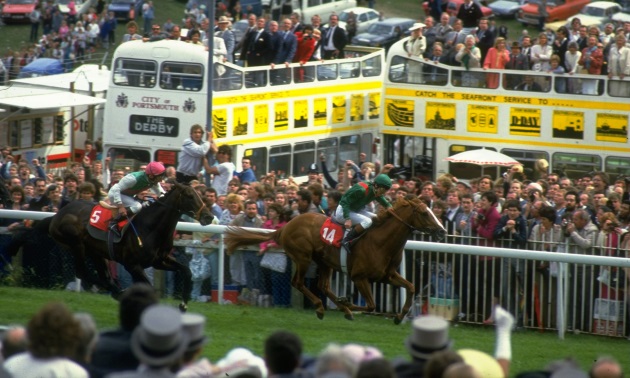
For those watching on TV at home, the camera angle changed shortly before the runners entered the final furlong, by which point Dancing Brave had just about moved to the front of the chasing pack behind Shahrastani, who still had a couple of lengths in hand.
Dancing Brave continued to eat into that advantage throughout the final furlong, but, inside the final 50 yards, it became clear that he wasn't going to get there, Shahrastani still half a length clear at the winning post. Swinburn saluted the crowd as he crossed the line, though in a few more strides he'd have more than likely been caught.
Why was Dancing Brave unlucky?
Swinburn revealed afterwards that it had always been the plan to try and get first run on Dancing Brave, giving his strong-staying mount the best chance of success, and he certainly deserved his fair share of credit for executing those tactics to perfection.
It was clear to all those who saw it that the best horse had not won the race, though, and Starkey was inevitably apportioned most of the blame for a losing ride that he is remembered for perhaps above all else, despite a career in the saddle that featured 1,989 winners (including five classics).
Where exactly did Starkey go wrong at Epsom? In this article in 2014, Simon Rowlands (@RowleyfileRRR) used more modern methods – specifically sectional timing analysis – to dissect one of the most contentious renewals of the Derby in the modern era.
“It was not that Greville Starkey, the jockey of Dancing Brave, got too far back per se – Pour Moi [the 2011 Derby winner] won from further behind, as we have seen – but that he got too far back in what had been a steadily-run race despite the large field.
“Starkey was pushing along on Dancing Brave from before the sectional [measured from the path entering the home straight], and it was only late on that Dancing Brave made serious inroads into Shahrastani’s advantage. The latter had been always close up and struck for home over 2f out but was still running quicker than par late on, which made him more difficult to overtake.
“Those sectional mark-ups suggest strongly that Dancing Brave ‘should’ have won the 1986 Derby. As one wag in editorial just said to me ‘you don’t need sectionals to tell you that!’ However, sectionals further suggest that Dancing Brave – who was beaten by half a length – could be rated the winner by about two and a half lengths.”
The aftermath
At the time, it was entirely feasible that his Derby reversal would undermine Dancing Brave's achievements. Fortunately for him, though, he was one of the finest thoroughbreds ever to stand on four legs, and Epsom ultimately represented one of only two defeats throughout his career.
The other would be in the Breeders' Cup Turf on his final start, but by then he'd won the Guineas, the Eclipse, the King George and, most famously, the Arc. Incidentally, Pat Eddery took over the ride on Dancing Brave for both the King George (when he reversed the form with Shahrastani) and the Arc, robbing Starkey of his best chances at redemption.
As for Shahrastani, he is arguably harshly done by history. Although seen as a lucky Derby winner, his impressive win in the Irish version a week before Dancing Brace won the Eclipse yielded a Timeform rating of 135, making him one of the very best the Aga Khan has ever owned.
History will also tell that Dancing Brave was in a different league when the cards fell his way, however, and his Timeform rating of 140 has been surpassed by only six horses in our experience, namely Frankel (147), Sea-Bird (145), Brigadier Gerard (144), Tudor Minstrel (144), Abernant (142) and Ribot (142).
.jpg&w=300)
.jpg&w=300)
.jpg&w=300)

.jpg&w=300)


