
















 Radio
Radio

.jpg "Get Timeform ratings for every upcoming runner and past result, plus premium winner-finders including commentary, Flags, Pace Maps and lots more.")


 Url copied to clipboard.

Name
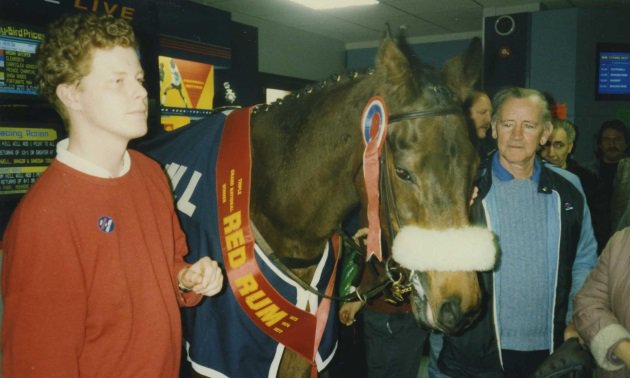
Dave Yates (pictured meeting Red Rum at the opening of a betting shop in Halifax)
Role
Newsboy, Daily Mirror
Date you joined Timeform
September 3rd 1990
What did you do immediately before joining Timeform?
Studied law at university. It was a bad choice as I am a very slow reader and there were so many cases to wade through. I can’t skim read and so go through every word. ‘The-cat-sat-on-the-mat’ - although obviously I read more erudite tomes these days. I tried to change but they wouldn’t let me. The swine.
What was your first role at Timeform?
Timeform Perspective, which involved editing and filling in the gaps in the racecourse reports and doing races off the TV if the company didn’t have a reporter there.
There’s a hell of a lot to learn about horse racing. What has stuck with you most about what you learnt during your Timeform years?
Every good form publication - or racing analyst - has one thing in common: they expose the pitfalls in taking a result at face value. The finishing order and the distances are there in black and white. Betty’s Boy beat Cyril’s Surprise by five lengths. But, if they ran the race again, would the result be the same? Maybe the winner got an easy lead, or sat out the back in a race where the leaders went too quick. Perhaps the ground, or the distance, favoured the winner. Was the third horse even trying? I suppose the other thing that has stuck is to fight against hype - not always easy in the red-top world, where the name of the game is often to give horses - or those associated with them - more ‘ra-ra’ than they actually merit.
There are pluses and minuses with moving to a new town, what are your lasting memories about your time living in Halifax?
I was an overgrown student when I arrived in Halifax, so in that sense it was the perfect place to be. The nightlife was great, pretty much six days a week, with a quiet couple of pints on a Sunday. I wasn’t exactly the star pupil at Timeform House, and in hindsight I probably should have been a bit more mature. Or at least pretended to be. It’s certainly a beautiful town. I come back every year and places like the Piece Hall are lovely to visit. When I was at Timeform I used to go and lie on the grass on a Sunday afternoon. There was a live brass band and, when they played God Save The Queen at the end of their set, everyone stood up. I didn’t cycle back then and it would certainly keep you fit to ride round that part of the world.
Thinking back, what was the job you enjoyed doing most while you were at Timeform?
I didn’t do that many jobs at Timeform. I was there for two and a half years and never got to be a comment writer, although I did steal one comment of an of-no-account hurdler. I wrote ‘of no account’ on the slip to send to the typing pool so I could put ‘comment writer’ on my CV. I think I enjoyed writing the script for Timeform Raceview - the premium-rate tipping phone service as was - because you could write in a chatty style and throw in a few gags of your own. It was the least loyal callers deserved.
What was your final role at Timeform?
Probably Perspective. I joined that department on September 3rd 1990 and am still waiting for a promotion.
Date you left Timeform?
May 1993
What jobs have you had since leaving Timeform?
I moved to London and went freelance. I had an American girlfriend at the time and she was supposed to be coming over from Philadelphia to the UK. I thought there was a better chance of hanging onto her if I lived in London. Sadly, the relationship faltered at the final flight when she began training to be a vet and stayed in America. Evidently she preferred sticking her hand up a cow’s backside to - well, you know.
By September 1993, I was back in West Yorkshire, working for the Press Association, which had moved from Fleet Street to Leeds. I was there until November 1999 before moving to London to go freelance - again - working for a few papers before joining the Racing Post in December 2000 and the Daily Mirror in May 2002.
Favourite racecourse/meeting and why?
Epsom, Derby. The most historic and the best race in the world - and I’ll fight anyone to the death who says it isn’t.
Best race seen live and why?
I’ve been so fortunate to watch many great races, and it’s the devil’s own job to single out a few. The 1998 Juddmonte International, in which One So Wonderful beat Faithful Son by a short head with Chester House the same distance back in third was probably the most exciting in terms of a close finish.
Watching AP McCoy finally win the Grand National on Don’t Push It was special, as were two of Kieren Fallon’s Derbys aboard Kris Kin (2003) and North Light (2004) and Frankie Dettori’s first on Authorized (2007).
I think the race that left the deepest impression on me was Denman’s Cheltenham Gold Cup in 2008. Sam Thomas seemed to pour it on from the front and Denman was so relentless. It was the first time I’d seen Kauto Star booted unceremoniously out of his comfort zone and he looked a sorry horse that day. Of course, Kauto Star returned to scale new heights and Denman was never quite the same horse again, but I’ll never forget the ferocity of that race.
Horse you have fondest memories of and why?
Yikes. Dancing Brave - I’m 51 and would imagine most people of a similar age would see his Prix de l’Arc de Triomphe win in 1986 as a treasured moment.
Desert Orchid - hardly took a lame step in his career, ran from the front and was the best horse from two miles to three and three quarter miles for seasons on end. All that and he was trained by that charismatic and wily old buzzard, David Elsworth.
What piqued your interest in the sport?
Nobody from my family is interested in racing, but I started betting when I was at school. Partly out of boredom, partly to impress my peers.
This is all sepia tinted, but betting shops were great places to hang around in the late 1980s, as the vast majority of punters were in there to back horses or dogs. Sports betting had yet to mushroom, there was no cartoon racing and no FOBTs.
The year I really got into racing was 1986, and both Dancing Brave and Desert Orchid were around at that time, which made it very easy to fall in love with a great sport.
I loved both Flat and National Hunt racing and, in my final year at university, I wrote to Timeform. The late Reg Griffin interviewed me and, to my surprise, gave me a job. Bingo.
Even now when I go to the races and look at thoroughbreds, I’m transfixed by them. The skill of a superb trainer is something to wonder at, and, while jockeys can sometimes be difficult, risking your life while having to starve wouldn’t be my idea of fun.
Give us a successful horse you spotted early on their route to the top?
Rail Link, André Fabre’s 2006 Arc winner, was one, and another was Cuis Ghaire, trained by Jim Bolger. She was the first of Galileo’s progeny to win at six furlongs and, while she didn’t quite reach the top, she won an Albany at Royal Ascot and was second to Ghanaati in the 1000 Guineas of 2009. I’ve always admired her trainer, Jim Bolger, who never gave a boring answer and loved a bit of verbal sparring. I had a big bust-up with him once, and our rapprochement meant a great deal to me.
Give us a horse you thought was going to reach the top but never quite made it?
It’s funny how punters seem to remember the successes rather than the failures, but one I got very badly wrong was Jan Vermeer, a son of Montjeu trained by Aidan O’Brien. He won the Group 1 Criterium International at Saint-Cloud at two in 2009 and returned to land the Gallinule Stakes at the Curragh - one of the last Derby trials - impressively. He went off the 9-4 favourite at Epsom but was beaten miles in fourth behind Workforce and never won another race.
What factor/factors do you think punters place too much emphasis on?
I think that’s a very difficult question to answer, because the market is constantly adapting, and secrets don’t stay secret for very long. I punted two-year-olds for years - horses that were running for the second time, having shown promise on debut - and the best thing was to come up against a highly touted newcomer. Some yards seemed to have an ‘Ascot’ two-year-old running every week and the neophytes’ home reputation meant that they went off stupidly short prices, even if they shouted their heads off in the paddock.
Another one is probably a bias towards recency. I admire Paul Kealy hugely, and, particularly in the winter, he seems to profit by tipping out-of-form horses to return to their best when they encounter particular conditions - against runners who have been in form but in races that place different demands on them.
What factor/factors do you think is largely overlooked by punters?
Again, punters adapt quicker than ever before, but all too often I think they pay too little attention to the way a race is run. One of the worst sayings in racing is that a winner has ‘done it the hard way’ simply because they have made all the running.
It’s amazing how often one looks at a race - particularly one with a single-figure field - in which the horses to the fore have obviously been favoured by the way it has unfolded.
Those runners who make ground with circumstances stacked against them are often worth sticking with, particularly when there is a likelihood of a stronger gallop.
Simon Rowlands was a contemporary when I was at Timeform. I do find his writing interesting, particularly his work on race times and sectional times, but ‘Roland’ wasn’t much use as a ‘wingman’ in the Cats Bar in Halifax of a Thursday night.
What one piece of advice would you give to someone analysing a horserace?
Probably a combination of the above but, principally, look for ways in which the result can be held up to the light. Crudely, the factors that influence a race are ground, trip, tactics and fitness. If you can find an argument as to why Cyril’s Surprise can beat Betty’s Boy the next time they meet - despite being thumped by five lengths - then you may well be onto something.
What would you change about the sport?
I would get the British Horseracing Authority’s top brass to sign a binding contract that they will never ban the ProCush whip. It is an essential tool and its use is easily defensible in trying to find which thoroughbreds are champions - and which are not.
Horses don’t know what the stakes are when they race, and the ProCush is the best way of visiting upon them that they must run until the jockey gives them the signal to stop.
One of the anti-whip brigade’s arguments is that racing will become more popular without the ProCush, even though the sport will continue to involve equine fatalities, both on the track and the gallops. That logic is from the funny farm.
The BHA should be mounting a front-foot, welfare-based defence of the ProCush.
Give us a trainer you think is underrated?
Tricky, because they don’t stay underrated for very long. For a National Hunt trainer, Alan King seems to do pretty well on the Flat and I’m sure there is more to come from Roger Teal.
Give us a young jockey you think will reach the top?
There’s plenty of sentiment in my answer, but I’d love to see Cieren Fallon follow in his father’s footsteps. He’s the champion apprentice, so he’s not exactly a dark horse, but the early signs are very promising. He seems to have all of his old man’s good traits.
Another I’d like to see do well is Kieran Shoemark. He served a drugs ban and I’m sure he has to be careful with his weight, but he got plenty of opportunities for Charlie Hills last year and has stacks of talent.
Over jumps, a big job will be Jonjo O’Neill jnr’s sooner rather than later. Either at Colin Tizzard’s or for JP McManus.
Give us a Horse To Follow for when we are back up and running?
Brentford Hope. Richard Hughes is in the early days of his training career but he must be excited about this son of Camelot, who won pulling a bus at Newmarket last back end despite shouting the walls down and generally looking as thick as two short planks in the paddock.
Also read Q&As with:

.jpg&w=300)
.jpg&w=300)

.jpg&w=300)


