















 Radio
Radio

.jpg "Get Timeform ratings for every upcoming runner and past result, plus premium winner-finders including commentary, Flags, Pace Maps and lots more.")


 Url copied to clipboard.

Assessing horse racing form, and striking a bet as a result of that, can be as complicated or as simple as you wish it to be. You could do something as basic as use form figures, or specialise in one area such as time or draw analysis, or you could create a multifactorial model of great complexity.
There is no clearly “right” or “wrong” way to tackle horse racing, which is part of its allure and also part of its frustration. That there are – theoretically at least – a multitude of factors that could be considered is indisputable, though whether or not all of those factors are important, and to what degree, is often a matter of context.
One factor that is always important, and which underpins horse racing and the odds offered on it – whether you are explicitly bothered with it yourself or not – is the concept of a horse’s raw ability.
Much of the rest of horse racing analysis can seem like tinkering around the edges: whether or not a horse is a superior or inferior athlete is likely to be the single most important piece of information you can lay your hands on.
Comparisons between one individual, or one team, and another can seem relatively straightforward in other sports, in which those individuals and teams often meet in competition, directly or through close association. Chelsea are a better football team than Burnley: the league table tells you that.
In horseracing, past head-to-heads between horses may be few and far between, and are by no means always definitive when they occur. More often they will not have happened at all.
Rather than giving up what might seem an unequal struggle, horse racing long since devised sophisticated means for inferential comparisons between horses that have never met or that have met infrequently enough for their respective merits to be open to dispute.
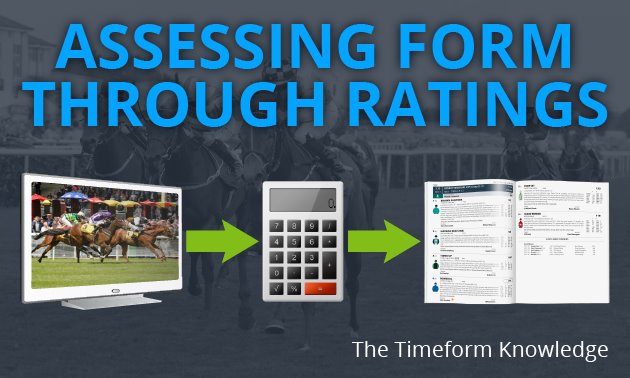
At the heart of this are “ratings”, which Timeform pioneered shortly after the Second World War and which are now widely adopted by individuals and racing authorities around the world to compare horses of different backgrounds, ages, locations and even generations.
Timeform’s form ratings range from 0 to 140 or more (Frankel was rated 147) on the Flat and to 175 or more over jumps, with the higher the figure the better. The scale expresses the theoretical difference between horses in terms of pounds (which are the preferred means for equalising perceived differences in horses’ abilities).

Time analysis – which will be dealt with elsewhere in this series – operates on the same level, but a horse’s overall time may be compromised by a number of issues, not least the pace at which a race is run. Only good horses can run fast, but both good and poor horses can run slowly.
Assessing a horse’s form through ratings is a complicated process, but it is manageable if a few important precepts are adhered to.
Experience has shown that the overall level of form of races is likely to be repeated with only a little variance in many cases. By “overall level of form”, we mean the general standard shown by the principals once adjustments have been made for conditions, weights carried, field size, margins between horses, and so on.

For instance, as the above table shows, winners of the Irish 2,000 Guineas at the Curragh this century have averaged a Timeform form rating on the day of 122, though two (both wide-margin winners who confirmed their worth subsequently) have been several pounds higher, while a handful have dropped below 120.
Even more significantly, the “race strength”, as judged by the ratings achieved by the principals weighted for finishing position, varies even less. All but one of those races – the notably strong 2009 running won by Mastercraftsman – have a race strength of 116 plus or minus 2.5 pounds.
It would take unusual circumstances for a winner of the Irish 2,000 Guineas to be rated higher than 130 or lower than 116; even more pertinently, it would take unusual circumstances for the race strength to be higher than 120 or lower than 113.
That alone tells us a lot more than we might have known otherwise. Historical precedent frequently matters, and that can be harnessed to assess form as we go along.
An assessment is made at the time and it is subsequently tested against reality. If the majority of the principals in the Irish 2,000 subsequently ran badly, or well, the initial assessment would be moderated accordingly.
The prior achievements of the horses in question are not ignored when assessing performance, but it can be shown that this matters more in some circumstances than in others. Where we know little about the horses, or where their participation in a given race implies something important about their perceived worth, the history of the race itself counts for plenty.
There will be more about “race standardisation” (as this form of analysis is called) in a later piece.
Importantly, the prior achievements of a horse, while usually significant, should not be used to define what it has achieved now without first employing some statistical checks. The rating a horse runs to is just one possibility in what may be a wide range of possibilities, and that one horse is likely to be just one of several horses in a race for which that is true.
Athletic performance is subject to variation – that is an inescapable fact – and there is no reason why athletic performance in horseracing should be any different.
As a result, Timeform establishes a rating for the race itself (more strictly, a range of feasible ratings) from consideration of all of the input probabilities available. Only after that might it be deemed worthwhile to “tie in” certain strands of form with others. There is an old saying in handicapping: “rate horses on races, not races on horses”. Or, interpolate, not extrapolate, in technical jargon.
Performance ratings are powerful things if handled properly, and they need not be restricted to quantifying a horse’s ability alone. The same scales can be applied to measure performance and merit in other areas, such as jockeyship, a trainer’s worth, the effect of the draw, and much more besides.
All of that will be covered, or at least referred to, in future articles in The Timeform Knowledge.

.jpg&w=300)
.jpg&w=300)
.jpg&w=300)

.jpg&w=300)