















 Radio
Radio

.jpg "Get Timeform ratings for every upcoming runner and past result, plus premium winner-finders including commentary, Flags, Pace Maps and lots more.")


 Url copied to clipboard.

'All human plans are subject to ruthless revision by Nature, or Fate, or whatever one preferred to call the powers behind the Universe.' - Arthur C. Clarke
Depending on which side the line is viewed, unpredictability is either a thing of beauty or an ugly effect, celebrated one minute and bemoaned the next. Few if any sports deal in unpredictability so much as racing, not only within the event itself but also the players involved and the conditions that prevail.
Little more than a month ago, the pulling power of British Champions Day threatened to leave the Arc de Triomphe meeting in the shade. The predictable projection path didn't account for a reinvigorated Treve launching fireworks in Paris, to be celebrated, nor the injury to Ascot-bound superstars Kingman and Australia, to be bemoaned.
Without the warped and wizened finger of unpredictability plucking at the race-time continuum, a perceptibly dull Arc would have been won by the flair-free Flintshire, with the knock-on effect that Ascot, billboarding Kingman and Australia, would indeed be the hottest autumn ticket in town.
That the best laid plans often go to waste is a fundamental life law, though confusing this particular debut, and the only question is this: is British Champions Day the best laid plan? The answer is, under the circumstances, yes. It might not do what it says on the tin and, related, it probably doesn't have the right name, but as a day, a draw and a definition for British racing it's a work-in-progress that's both working and in progress.
For some necessary context, let's look at the recent history of Champions Day, dipping in at various points in the style of David Nicholls (not that one) with British racing's version of One Day, or in this case One Month.
October 2001
It was a great year for manufacturing: the iPod, the Xbox, the boob tube, and Hear'Say. Flip flops became hip hop, Ricky Gervais became David Brent, Destiny's Child became Beyonce, and the Cheltenham Festival became a foot and mouth depot.
This month, on the track, the mighty High Chaparral announced his arrival by ploughing through the heavy ground to win the Racing Post Trophy; the QEII was 2001: A Race Oddity when Summoner rewrote the definition of pacemaker as he slipped away with the prize; and Nayef won a Champion Stakes that was as famous for the those who didn't turn up as those that did, the by-passers including Galileo, Sakhee, Medicean, Golan and Fantastic Light.
The alarm bells for the 'Champion' Stakes were ringing back then.
That was the fifth edition of Champions Day in its original guise, at Newmarket, and in the Racehorses Annual of that year, 2001, Timeform said: 'Giving a race meeting the title Champions Day is, in a sense, acting as a hostage to fortune since the presumption must be that more than one race on the card will settle a championship every year.'
However misguided and one-eyed the criticism, the 'Champions' banner continues to be a rod for the day's own back, despite having a Street-wise Rod at its back, because racing simply doesn't lend itself to peaking to produce a host of definitive champions on demand. It's merely a problem of semantics, but one that leaves the event open to a base attack.
October 2005
A racing year that belonged to Jamie Spencer, who divorced Ballydoyle, married Emma Ramsden and ended up champion jockey. The Irish title, which Spencer had won the year before, was passed to Pat Smullen, who wrapped it up in October with a flurry of winners for his boss Dermot Weld, including Polished Gem who sluiced through the mud at Leopardstown on the last day of the month.
The crowning glory for Spencer in 2005 was winning the Champion Stakes on David Junior, significant because it was just about the last of the strong renewals at its Newmarket home, with a field of fifteen runners and, moreover, an average Timeform rating in the mid-120s.
The following table shows, in Timeform ratings terms, the difference in quality between the Champion Stakes in its last five years at Newmarket and the three runnings since it was revamped, revalued and repositioned to Ascot.

In short, the Champion Stakes, the focal point on a focal day for British racing, was something of a sinking flagship, losing buoyancy and set adrift in international waters, but the rescue mission has proved successful in getting it back on the radar, which was necessary first and foremost before setting a course to the coast of France or America to reclaim some lost racing land.
The average rating of this year's Champion Stakes field, incidentally, is down to 122.3, but prejudging tells only of the standard going in, not coming out, and the figure would have been nearer 125 had Australia and The Grey Gatsby arrived as intended, the former injured and the latter withdrawn due to the ground. The pesky ground.
True, staging Champions Day in mid-October tempts torrent trouble, but we're back to the point of predicting the unpredictable, of controlling the uncontrollable, and whether the event's home is September, October or of no fixed abode, there'll never be a resolve for all forces and all horses. Champions are determined through the season, not on an afternoon. All that British racing can reasonably do is put on a tub-thumping, blood-pumping day's racing to celebrate the sport, and shout about it. That's the best laid plan. And, as far as I can see, that's exactly what is being done.
October 2012
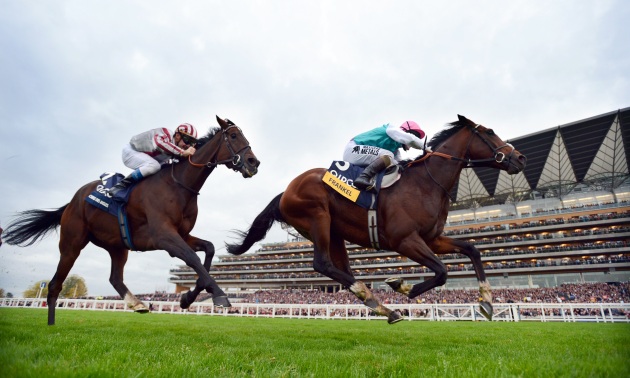
Part of Frankel's monumental legacy is Champions Day, and indeed Future Champions Day. The talent of Frankel was matched by the vision of Sir Henry Cecil, whose programme for the ultimate racehorse comprised campaign climaxes in the three British bastions that are emphasised by this weekend - the Dewhurst, the QEII and the Champion Stakes.
The poor weather on the 20th October didn't prevent 32,000 people attending Champions Day, nor did it stop Frankel strutting his sensational stuff, nor Sapphire earlier on the soft-ground card, incidentally a day after this year's QEII contender Custom Cut had shown the first flickers of his ability under testing conditions as a two-year-old.
October 2013
A slow-burning week towards Champions Day began with the debut of Custom Cut's relative, Amber Romance, who showed little then but was transformed when getting on heavy ground at the start of this year.
At Ascot, there was something old (bad weather), something new (no Frankel), something borrowed (an incongruous big-field handicap) and the something blue was Godolphin's Farhh winning the Champion Stakes, defeating Cirrus des Aigles and Ruler of The World in a thrilling finish, arguably the Flat race of the year, anywhere in the world.
The short story of Champions Day is a classic tale of triumph over adversity, of a transformational journey. There are more chapters to be written, more characters to be introduced and more twists to come, but the current narrative has never been more exciting, which is something to celebrate rather than pick at. The timing, the name and the structure mighn't be perfect, but imperfections and unpredictability is to some extent what makes racing, and this day, above all others, champions the sport. That's why it's Champions Day.
As with any story, the subplot is often as interesting as the main drama, and now is the time to join up those random bolded-up dots in the passages of Champions Days past for a denouement with a pointer to this year's extravaganza.
It's as clear as mud, the mud that his sire High Chaparral revelled in, the mud that his dam Polished Gem sluiced through, and the mud that his half-siblings Sapphire, Custom Cut and Amber Romance have all shown a liking for. His family history strongly suggests that Free Eagle will handle testing ground, and his breathtaking reappearance at Leopardstown strongly suggests he's a champion in the making. Combine the two, and Free Eagle could well light up Champions Day.
.jpg&w=300)

.jpg&w=300)

.jpg&w=300)