















 Radio





 Url copied to clipboard.

Over the decades, Timeform has been inadvertently responsible for altering some aspects of the racing lexicon, for better or worse.
There is the Timeform “p” (indicating the likelihood of improvement on a rating) and "large P” (indicating the likelihood of considerable improvement, or considerable disappointment, depending on the outcome), the use of the word “penultimate” in a largely non-ironic setting, and a predilection for a frequent-overuse-of-hyphen style seen nowhere else in the English-speaking world.
Perhaps the most famous, or infamous, example of this contribution to the common parlance is the “Timeform squiggle”. Or, in racing vernacular, “The Dreaded Timeform Squiggle”.
Early editions of Timeform’s Racehorses annuals backed up a “§” (squiggle) attached to a horse’s rating with some inflammatory language, such as “an arrant rogue” and “refuses to do his best”.
That was all a bit subjective, not to say potentially litigious, even though, as Timeform’s founder Phil Bull observed, “you can’t libel a horse, brother”.
The definition of a squiggle was changed about 20 years ago to “unreliable (for temperamental or other reasons)”. Timeform is primarily concerned with effects – not their causes – then: a squiggle indicates unpredictability, not what causes that unpredictability.
There have been some notable recipients of the Timeform squiggle over the years, including Cheltenham Gold Cup winner Bregawn, King George VI and Queen Elizabeth Stakes runners-up Norse Dancer and Papal Bull, Champion Hurdle second Harchibald and top-class jumper Tidal Bay (“a reformed character”, or “we got it wrong”: either way, he no longer has a squiggle).
This may all seem rather academic for a blog which usually aims to look ahead, not back. So, in an attempt to justify my reputation as “the man who puts the anal into analysis”, I investigated the incidence of squiggle horses by-sire, the idea being that a high or low incidence should guide as to how little or how much to trust the offspring of such sires, especially when little else is known about the offspring in question.
The following are extracts of the “best” and “worst” sires, with the data taken from all Flat racing in Britain and Ireland in 2011 to 2013 inclusive. The figures are for individual horses which had pre-race §s on their ratings at least once in that period (the overall incidence of such horses was just under 3% in the entire horse population) and only sires with 70 or more individual runners were considered (there were 112 of them).
In addition, and in recognition that applying squiggles can still be subjective, even if the terminology is much less so these days, I formed a “gameness index”, taken as the ratio of wins to seconds for a sire’s offspring in the same period. The idea is that a certain genetic reluctance to battle when the chips are down might be reflected in a tendency to finish second rather than first.
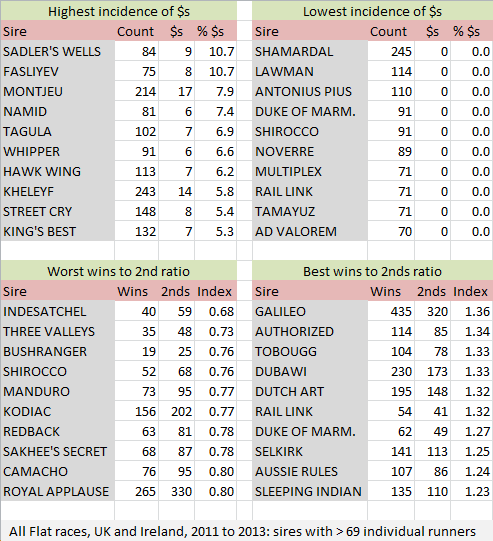
There are some familiar names in the “Hall of Shame”. Most people with an opinion on this matter already will not be surprised to see the likes of Montjeu, Hawk Wing and Fasliyev high up the list of sires by incidence of squiggle.
What was news, to me at least, was that Shamardal had an unblemished record as the sire of a large number of squiggle-free horses. But that is nothing compared to the shock of seeing Antonius Pius in that list of sires whose offspring escaped the squiggle treatment.
Antonius Pius was a dodgepot himself, failing to win after his two-year-old season and earning both a squiggle and the sobriquet “Antonius Pigus” at Timeform. Some of his offspring in the 2011 to 2013 period got close to squiggles, but, rightly or wrongly, none of them suffered that ignominy. Like father, unlike son/daughter, in this instance.
At the top of the list of sires whose offspring have won a higher proportion of races than they have finished second in is the mighty Galileo, the pre-eminent sire of recent years. Galileo had nine squiggle horses from 435 individuals in the period under review (2.1%), which is only slightly better than average. But it seems that, when it came to a tight finish, his sons and daughters in general put their heads down and battled.
The finest breeding, best physique and most fastidious human care can only take a horse so far. What often separates the winners from the losers is a willingness to put it in when required, and to keep putting it in: mental toughness, as it were.
That is a thing well worth remembering when selecting your bets.