








Grading, rules and regulations


 Url copied to clipboard.

By Timeform — published Wednesday 12 August, 2020 at 14:32
Learn how greyhounds are graded and the strict rules and regulations that owners and trainers must follow in order for their dogs to reach the track.
RULES, GRADING & MORE
All persons involved with greyhounds, whether it be trainers, owners or track staff must adhere to the Rules set out by the governing body, the Greyhound Board of Great Britain. An extensive list is provided on their website at www.gbgb.org.uk, including welfare standards to ensure greyhounds are cared for whilst racing and into retirement.
GRADING
Of course not every greyhound can emerge as a Derby contender, or even an open race prospect, and one of the most important aspects of greyhound racing is the grading system, the aim of course being for each track to provide competitive, exciting racing achievable by placing dogs of similar ability against one another, and providing each of the six dogs in any particular race with an equal chance.
Every greyhound competing under the care of a contracted trainer must first undergo a series of qualifying trials (usually two) over the distance the trainer wishes the dog/bitch to compete, though racing managers may at their discretion require further trials if they feel they needs further evidence of a greyhound’s ability/running style.
Final time is a pivotal aspect of greyhound racing and the racing manager will make a judgement on the grade the dog should compete in based on those trials. Track depending, grades range from A1 (best) to A12.
Once a greyhound is “graded on”, usually staring out as pup (under 2 years of age), the job of a trainer is to enhance each greyhound in their care through the graded system, the objective being to get up as high as possible (A1 standard) before hopefully, a crack at open races, if ability dictates.
As a rule, the system sees dogs fluctuate through the grades, of course moderate or exposed runners, just like horses, tend to find themselves staying low or dropping down the graded ladder as their career lengthens.
No allowance is made for sex in graded racing and dogs and bitches compete on a level footing.
PRE-RACE
Now the more mundane part of qualifying for racing is achieved, the more exciting part of competing in races can begin, and most trainers follow a very similar pattern of race day behaviour, beginning with a pre-race meal to ensure a greyhound is able to compete at it’s optimum.
On arrival at the track all greyhounds have their identity checked and are weighed (must be within a kilo either way of its last run) whilst a vet will check each and every dog’s physical condition to ensure it is fit to race.
At any stage a GBGB steward may seek to sample dog (s) at the track in order to maintain the standards set by rules of racing.
Once kennelled each dog is left to rest, with nobody permitted to come into contact with them before their intended race.
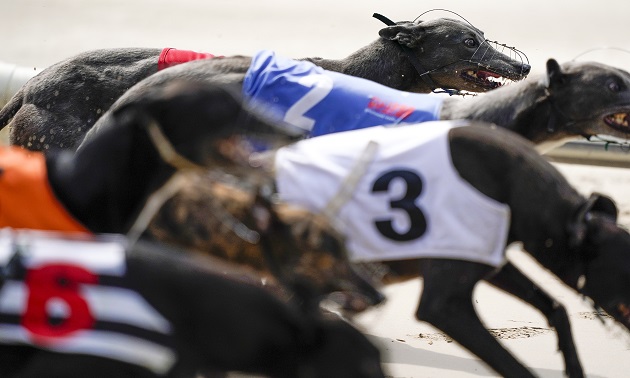
Closer to race time, dogs are handled by kennel staff, who will let each competitor stretch off whilst also fitting them with their trap number jacket and racing muzzle. Each dog will then get their identity checked, to ensure the correct dogs are lining up against each other, before being presented for parade in front of the grandstand for spectators to view and ultimately make their selection.
THE RACE
All greyhound racing takes place on sand, predominantly level break races run over four bend distances from 380-500 metres.
Greyhounds are placed into starting traps assigned by the racing office, giving each competitor an equal chance of breaking on terms. Once out of the traps each dog essentially runs flat out, their running style inherent and often defined from the schooling track.
The race can often be defined by points, with the first bend often crucial to a greyhound’s chance of winning. The race will often take “shape” with early-paced types breaking swiftly from the traps and assuming prominent positions, whilst closely pursued by slow away types who may well be inclined to finish strongly, with the exciting action often reaching a climax off the final bend as greyhounds stretch every sinew to hit the line in front.
The greyhound who hits the finish line first is declared the winner, though regularly two, or possibly more greyhounds will cross the line together, leading to a photo finish and, following close inspection, potentially a dead-heat.
Unlike in horse racing, if a greyhound, irrespective of its finishing position, is deemed to have interfered with a rival it will not lose the prize money and the result will stand. However, it may well be required to face subsequent clearing trials or ultimately disqualification from future races, on account of being awkward or causing deliberate interference.
POST RACE
Once the race is complete greyhounds remain full of adrenaline, understandable given the nature of their job. The final objective is to ensure all remain well hydrated and washed off. Allowed to cool off for a period, greyhounds are then transported back to their trainer’s base for rest and recuperation.
Url copied to clipboard.